Sunday, August 8, 2010

Less for More


A few months ago, I dined at Spunto in Soho for lunch, and I think it's time I said something about it. Because after all these years, my long-feared suspicions have been confirmed: The thin-crust pizza market is a racket.

Does it taste good? Sure. Is it worth the price you pay? Not unless it's Marion's.

Just look at the menu: $13 for a large pie without any toppings. Since plain-cheese pizza sort of defeats the purpose of eating pizza in the first place, an additional layer of toppings will cost you five more bucks. I'd be tempted to try one of Spunto's house specialty pizzas if it didn't put me out $24.

I realize that some people are okay with paying whatever for thin-crust pizza because they prefer that to thicker crusts. Honestly, I wouldn't be opposed to the prices if I didn't get hungry an hour or two later.

So if anyone else's experience is anything like mine, thin-crust pizza ultimately serves as a snack, but you end up paying a full meal's price for it. This isn't right, especially at chains that charge the same for thicker crusts.

Preference is one thing; principle is another.

Monday, August 2, 2010

One Ring To Bind Her


How to propose to your girlfriend in 13 steps:
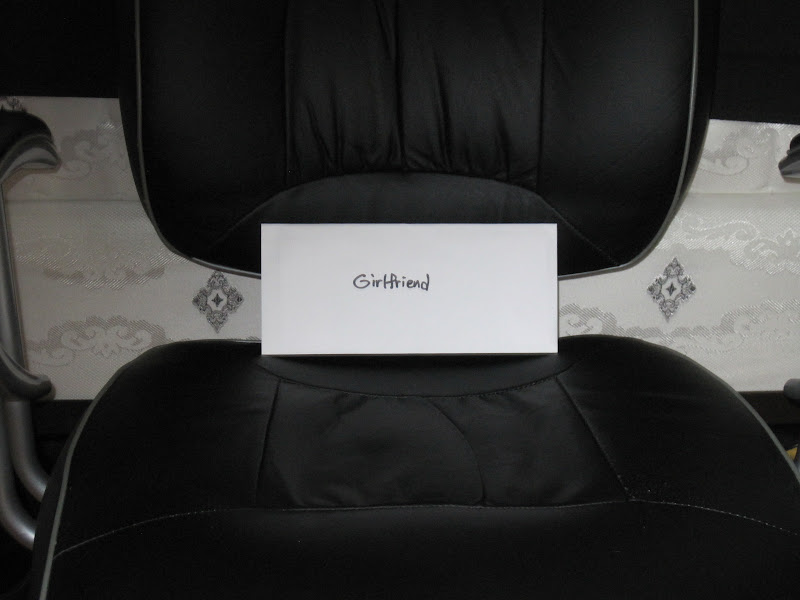
  1. Create a relationship crossword puzzle. Include inside jokes, pet names, common likes, and references to relationship history.

  2. Leave crossword puzzle for girlfriend to find when she comes home.


  3. Wait for girlfriend to meet you at the secret location revealed by unscrambling certain letters on the crossword. One location could be Belvedere Castle in Central Park.
  4. Give girlfriend a big hug and kiss when she does finally find you off to the side of the castle, away from all the tourists.


  5. Present her a single rose. Then say, "Well, I guess we can head back home now." Make sure she knows you're not serious.
  6. Pull out the ring and say "Do I even have to ask?" with a knowing smile. But follow up with "Will you marry me?" just to be sure.
  7. Take pictures.


  8. Appreciate the complete randomness and coincidental timing of a former hockey teammate running into you moments after popping the big one...
    "I was strolling through central park on Saturday afternoon with a lovely coed. As we ascended to the platform of the castle that resides off the southwest edge of the Great Lawn, I glanced to my left and saw a very familiar towering god-like figure. So familiar, after a quick double take I zoned in and got closer, it was no other than the one the only Kenny "Marquee" Devine. Not only was the sighting out of left field, couple it with the fact that literally moments earlier in that exact spot with his princess in hand, he asked the lady of his life that eternal question.....and she graciously accepted. Hearts across America broke this weekend. Kenny, congrats big guy...From every last member of the Tea Time community, we wish you nothing but the best....salud"
  9. Take more pictures.


  10. Accept the fact that, yes, Billy Squier's "Love Is The Hero" is indeed playing in your head. But it's cool.
  11. Dine at a great steakhouse.


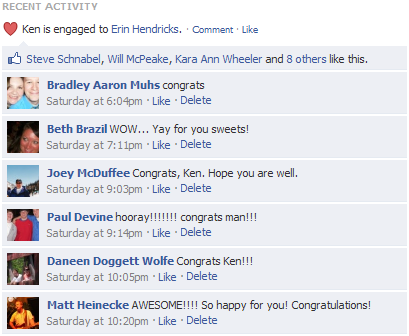
  12. Tell the world.


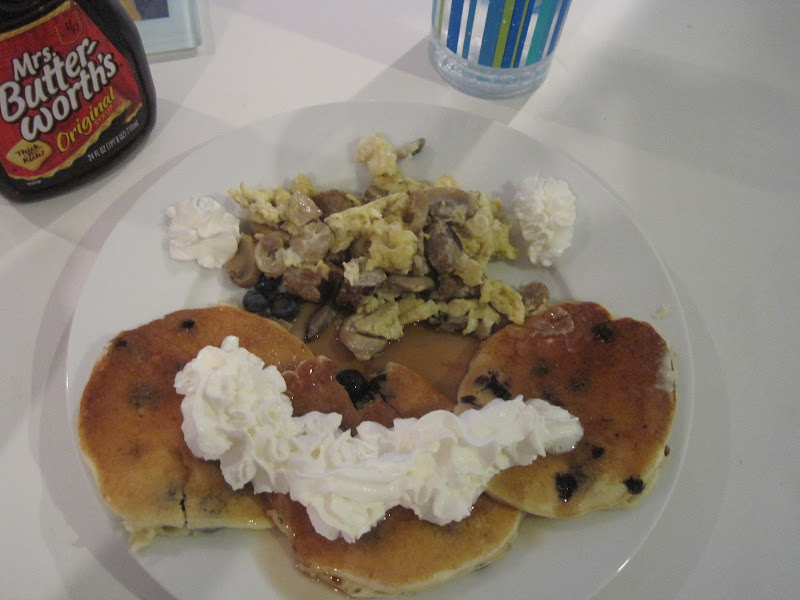
  13. Feast on a celebratory breakfast the next morning, with whipped cream symbolizing your sentiment.

Wednesday, July 21, 2010

Rest in Peace


NEW YORK—Shortly after 9:30 p.m EDT on Monday, July 19th, Dell computer White Lightning was officially pronounced dead from owner decommissioning. Lightning, a Dell Dimension XPS T550 purchased for around $3,200 in July 1999, was just days away from what would have been its eleventh birthday.

During White Lightning's 10-year tenure, Bill Clinton was impeached, MySpace blew up, the Red Sox won the World Series, and owner Ken Devine got a girlfriend.

Devine maintains that Lightning had a great run, but he's alone in that sentiment. Every other person who has come into contact with the mainstay machine insists that it was a painstakingly slow death over the course of a decade where computer technology advanced by several leaps and bounds. In fact, family members attest that Devine's stubborn refusal to even consider replacing the sluggish dinosaur bordered on cruelty—more so, perhaps, to himself.

Yet critics agree that the 550 MHz has-been had a short stint of glory in its first year of existence, when 16-megabyte video cards ruled the personal-computing frontier, and 20 gigs of hard-drive space was much more than anyone would ever need.

Yes—people really lived like this.

No one's sure how, but White Lightning managed to run on the Windows 98 Second Edition operating system all the way until late 2006, when a freak system-file deletion wouldn't allow Devine to re-enter Windows. A tech-savvy co-worker came to the rescue and bypassed Lightning's hard drive by adding a second one running Windows XP—an operating system already half a decade old.

Devine enjoyed the much-more-stable XP, but had his first realization that Lighting was behind the times when he received an iPod for Christmas in 2007. The portable music device was a fraction of the size of his computer, but at 80 gigs, had the storage capacity of four times more than his once-super computer.

After months of contemplation, Devine reluctantly decided on Monday that it was time to replace White Lightning with Black Thunder, a far-superior Dell machine configured by a pair of former co-workers who felt sympathy for Devine's situation. The duo was compelled to end the years of neglect after learning of Devine's surprising contentment with his long-running personal-computing history. Oddly enough, the speedy PC now adored by Devine sat in his closet for the past 15 months, just waiting for its chance.

"I just felt like it was time," said Devine on retiring his old friend. "Whitey was taking longer naps, and he just sort of gave up when I tried to watch videos on YouTube. I only saw a new frame like once every 15 seconds."

Devine revealed that the key to preserving such an antiquated computing device was a steady diet of program management and maintenance, particularly with nightly shutdowns.

But more than anything, an unprecedented level of patience.

"The good news is now I don't have to put my clothes away or make a sandwich while my computer is booting up," he said. "But I think this whole experience built a lot of character, both for me and White."

"I wouldn't change a thing," he added.

Lightning is survived by PC siblings Blue Bronco and Black Stealth, the latter of which has been in a coma for the past several months. Brother Red Bull passed away quietly in 2007.

Monday, July 5, 2010

Why Soccer Still Sucks


Four years after writing about the issues I have with soccer, I have to say I've enjoyed watching the latest World Cup, and my interest in the game—with its finesse, chess-match strategy, and surprising level of physicality—has increased.

But the more I try to appreciate the sport, the more it frustrates me. Soccer's still got some issues to work out, particularly with unfairness...

#1: Ghana's a Goner

The latest exhibit: Ghana falling in penalty kicks to Uruguay on Friday. I really have a problem with the intentional handball by defender Luis Suarez to prevent Uruguay’s instant death in the final minutes of extra time.

Would I have a problem if Ghana forward Asamoah Gyan had converted on the ensuing penalty shot to clinch the contest (which he should have)? Not with the outcome, no.

Do I blame Suarez for reacting in a manner that would deny a game-winning goal? Not at all. It was a natural act of last resort and self-preservation.

The problem I have is with the rulebook, namely the black-and-white nature of the handball infraction. There's a big difference between an unintentional handball at midfield and a deliberate handball at the goal line to prevent the ball from going into the net. The fact that the handball rule does not distinguish between these two situations that carry very different implications is a serious flaw, because it allows for cheating.

And that's what happened Friday—Uruguay cheated. Okay, technically they didn't "cheat" within the laws of the game, but it was cheating at its core. From a legal perspective, you could say the handball was a smart move because it was the only option to stay alive. But if the rule was truly fair, this option shouldn't have existed at all—the goal should have been awarded instantly on account of goaltending (one thing basketball does get right). I'm astonished by the lack of challenge and outrage with this rule, especially from Ghana. But writer John Leicester is with me:
"Suarez knew what he was doing. He took a calculated risk... He knew that the punishment for handling would be a penalty for Ghana. But that had to be better for Uruguay than losing to a last-gasp goal."
In a small measure of consolation, Suarez will sit out the semifinal match against the Netherlands, but will return for the finals if Uruguay advances. FIFA found Suarez guilty of "denying the opposite team a clear goal-scoring opportunity."

That's a nice way of putting it.

In a just world, the Ghanaians would be the ones preparing for the Netherlands on Tuesday. It didn't matter what happened on their penalty shot—the game should have already been over.

For more evidence that the handball rule enables cheating, look no further than Suarez himself, who instantly celebrated from the sidelines when Gyan booted his penalty shot off the crossbar. Much worse, he openly expressed zero contrition with his decision, claiming the punishment of being ejected from a World Cup game is "complicated."

"The way in which I was sent off—truth is, it was worth it," he said. "I think I made the best save of the World Cup."

#2: No Instant Replay

The USA, England, Mexico, and Portugal were all victims of poor officiating. If there was instant replay, who would be playing Tuesday and Wednesday? The 2014 World Cup has to get the officiating system right. With the level of international outrage that only soccer can present, I'm hopeful.

#3: Low Scoring

Out of all the games I've watched this World Cup, the one thing that continually irks me is the lack of scoring opportunities. This is the biggest thing holding the sport back; the main reason why most of us play soccer when we're young but only catch it once every four years.

It's an accepted truth that you tend to like things you grew up with, the only things you knew. Thus, many non-American "football" fans have no problem with low-scoring matches because they didn't grow up with the NFL, NBA, or NHL, where scoring is frequent and gratification instant. The disparity in the popularity of the game outside the United States can be explained by cultural expectations.

But as I've watched these matches, I've thought about ways to balance the sport and improve the game so that it's less restrictive and more interesting to watch. Here are a few suggestions that will never be adopted, but whose implications are interesting nonetheless:
  1. No offsides
  2. . Is there any justification to leave offsides in the game other than the fact that it's always been there? Like hockey's riddance of the two-line pass, eliminating offsides would be the easiest way to improve the game without fundamentally changing it. As in hockey, forwards would actually be rewarded for slipping behind their defenders. Scoring opportunities would increase, saves would be made, and overall interest would heighten. Offsides could even be redefined to be when a player advances into the penalty area before the ball has entered it (again, similar to hockey, the sport it most resembles).

  3. Fewer players
  4. . Reducing each side from 10 players to eight would be a pretty radical change, but I can't help but get excited about the passing and shooting lanes that would open up, and the faster pace of the game overall. One of the main reasons shots are so low in soccer is simply because there are too many players that clog up the area in front of the goal.

  5. Penalty-kick distance
  6. . Everyone knows that relying on penalty kicks has never been a great way to determine the winner of a match. So why not keep the kicks but move the shot placement back to the top of the penalty area? You know, to give goalies a higher probability of stopping the shots than Stevie Wonder.

    And while we're speaking of overtime, why is there no sudden death in the extra-time period (the opposite problem the NFL has)? Isn't the point of overtime to fairly determine a victor in a timely fashion?

    Here's what it's like in the current system: Two teams battle to a tie over the course of 90-plus minutes. One scores a huge go-ahead goal in the extra session, but not so fast—the game isn't over. They've got to continue on in the hopes of not allowing their opponent to tie the score again for the remainder of the 30 minutes. Apparently, people love seeing penalty kicks.
If you're a purist against these rules, consider these stats through July 1st from novelist Richard Greener:
  • The Group winners in the 2010 World Cup (Uruguay, Argentina, United States, Germany, Netherlands, Paraguay, Brazil and Spain) averaged 656 touches per game, with only 6.3 shots on goal in a 90-minute contest.
  • Argentina, the most aggressive offensive team, attempted a shot on goal 1.28% of the time it touched the ball. They've averaged 2.3 goals per game.
  • The worst teams, Honduras and New Zealand, averaged only 1 shot on goal per game. Honduras played their entire schedule of games without making a single goal.

In the absence of alterations to the game, I have to agree with Greener's prediction that American interest in soccer will remain largely unchanged in the years to come, unfortunately:
"Here, unlike other places, we look for sustained action and the ever-present opportunity to put points on the board. Finding neither in soccer, interest in the United States will remain limited to events like the World Cup, with fan interest created by the marketing of false patriotism for a few weeks every four years."

Guess I'm not alone after all: Why Soccer Sucks: The Antidote To World Cup Idiocy.

Thursday, June 17, 2010

Seconds Out


Sometimes things don't end the way you want them to.

After headlining serial television through most of the 2000s, 24 finally bid farewell to TV on May 24th (fittingly), capping off eight adrenaline-pumping seasons. But compared to its groundbreaking genesis that reinvented how stories could be told on TV, 24 went out with more of a whimper than a bang.

The invincible Jack Bauer was once again betrayed by the country he's saved so many times from total annihilation, and is once again on the lam. There was a tender scene with him and Chloe as the final seconds ticked away, but it wasn't the particularly affecting conclusion that 24 deserved—at least, at one point in time.
"24 came onto the air in 2001 as a form-breaking serial that looked strikingly different from anything else on TV. As all successful insurgents do over time, though, it became another institution, with its own familiar forms, tropes and patterns. And last night, 24 said goodbye—to TV anyway—with a closing that was much more like just another season finale than a series finale." —James Poniewozik
The major impediment with 24's finale was that, after all this talk about this being the end, it wasn't—the last episode just served as a setup for the forthcoming movie that's been in the works for months. And it didn't help that 24 had an impossible act to follow, with most of America still reeling from the fever-pitch finale of Lost the night before.
"I know these last few months have been difficult ones. It must be hard to look at the brass-band sendoff for Lost, whose serialized story was made possible by your success, and not compare it to your own less-glorious finish." —Sam Adams

It's interesting to juxtapose the two serial thrillers, because for me, Lost was always second to 24—at least for a while. And in terms of where 24 stood, there was no clearer marker in the sand than when I called Professor Thom's in January about when the next Bauer Hour would be. The NYC bar had held 24 viewing parties for years, handing out free shots of Jack Daniels every time Jack killed someone. But when I spoke to the owner, he said that they had canceled the Bauer Hour this year due to lack of interest. However, still on the schedule was Lost, whose viewing parties continued to be marked by long lines and sitting-room-only crowds.

In the end, 24 could have learned from Lost. Plotting a show's demise in its prime is never easy or sensible in today's philosophy of goldmine entertainment, but 24's atrophy was self-inflicted, opting to exhaust itself over the course of 192 episodes rather than go out on top. Even as a die-hard fan from the very first hour, I was hoping that the producers would end the series after three or four seasons (circa 2005), having Jack die a hero's death in the final seconds (the only truly fitting ending). Because even though 24 suspended reality from the start, it was still grounded enough where there was no way someone could have as many bad, sleepless days as Jack Bauer, right?

But as it turned out, 2005 was right around the time when Jack Bauer became a household name. With the 24 epidemic spreading, I can't completely blame FOX for keeping the juggernaut rolling, but they had to know that the longer they dragged it out, the more preposterous it would get and the less serious people would take the show. As Lost taught us, a serial is a different animal that has the potential for huge payoffs. The caveat: You've got to end it at the right time, on your own terms. Compromise, and you'll have a price to pay, as well as a far dimmer legacy.


That's not to say 24 didn't have some good seasons in the latter part of its run. Seasons 5 and 7 are actually two of the stronger ones, continuing to push boundaries and execute impossible twists despite waning originality. But there was an aura from the first few seasons that was gone.
"Those were heady times, when everything seemed new. People went nuts for your continuity-driven concept, which seemed to flout every canard about TV's dwindling viewership. Rather than chase after an audience's attention, you demanded it, and promised to reward it as well. The heedless momentum of your real-time rush turned the rules of television inside-out. Rather than returning to the status-quo ante at the end of every episode, you promised that things would change, and keep changing. There was no going back." —Sam Adams
With the show's rigid structure and the act of resetting of the clock each season, the writers had little wiggle room in the corners they were forced into. But you have to give them credit for surprising us more than you thought they could for eight entire seasons, because most shows couldn't have survived that long with a gimmicky plot conceit. Even when you thought it was just another mole inside CTU or a seemingly benign subplot, there was usually something else in play. Our jaws dropped less, but the turns weren't all predictable.

"I know they get incredibly burnt and bent," Sutherland said of the show's writers. "The more you do it, the more you paint yourself into a corner, and I think, 'How many times have I played the same moment over and over?'"


One of the biggest corners was limiting the counterterrorist operation to Los Angeles for most of the show's run. Aside from a stint in Mexico during Season 3, it's a shame that it took 24 six seasons to get out of LA, because the last two seasons (set in Washington D.C. and New York City) added a much-needed freshness. But it was too little too late.

Executive Producer Howard Gordon said he called it quits because he couldn't see another season in the cards.

"The real-time aspect was one of the propulsive devices, but it was very restrictive, even with the absurdities, the license we allowed ourselves."


But no matter how implausible the twists were, the backbone of the show—Kiefer Sutherland—was consistently remarkable. His unceasingly intense portrayal of Jack Bauer as hero/antihero was the one thing that was always believable. Even when the quality of the show dipped, Sutherland was a class act that compelled us to watch from week to week, season to season, to see how much saving the world several days over could torture one man's soul.
"There are many moments in television that are simply unforgettable, and the moment Jack was told that Renee has been killed ranks among the most gripping I've ever seen. There seemed to be so many emotions bottled up in his eyes. For all the things he's seen, all the predicaments he's lived through, and all the bullets that have whizzed past him, THIS moment seems beyond his comprehension. It was a finely tuned, well-oiled moment of epic drama." —Dereyck Moore

One thing 24 will be remembered for was its uncanny ability of being a step ahead of real life, with its 9/11-style attacks, means-to-an-end torture tactics, government conspiracies, and an honorable black president. Not to mention viewing habits.
"If nothing else, 24, you helped changed television forever, pushing the networks towards uninterrupted seasons and redefining the way the industry used DVDs to market their shows. Every time someone devours a complete season to prepare for the next one, they have you to thank." —Sam Adams
When asked if he would have rather had 24 end a year apart from Lost (which would have happened if not for the writer's strike in 2008), Gordon was both humble and cognizant.

"All I can say is, I hope we will be missed as much as Lost. I hope we will both be missed."

Lost may be my favorite TV series, but there was none more addicting or instantly gratifying than 24. I reminisce on getting hooked on the show during my latter days in college, watching it week to week in dorm rooms while the rest of the world was somewhere else. That's what I miss the most.